Pages

Showing posts with label Book Review. Show all posts

Thursday, April 3, 2025

"Yellow World" by Noel L


The King in Yellow is a collection of short stories written by Robert W. Chambers and published by F. Tennyson Neely in 1895.


The King in Yellow takes place in an alternative 1920s, and the events in the book are centered around a fictional play of the same name and its effect on the world. There are 4 stories contained within the book.


The first story, “The Repairer of Reputations,” follows a man by the name of Hildred Castaigne, who has had his psyche negatively impacted by a rather serious fall of his horse. His mind has been further corroded by his reading of “The King in Yellow,” which is implied to have driven him to madness, and hatches a plot to take the throne of a so-called “Imperial Dynasty of America” which relates to the figures found within “The King in Yellow.”


The second story, “The Mask,” takes place in France and is narrated by a painter named Alec, who is staying with his friends Boris and Genevieve, who is Boris’s girlfriend. Boris is a sculptor, who concocts a mysterious solution capable of turning living things into marble. At the same time, Alec has found and read “The King in Yellow,” and shortly afterwards, falls into a state of delirium, made worse by the tragedy that unfolds throughout the short story, resulting in Alec’s despair and madness.


The third story, “In the Court of the Dragon,” is written from the perspective of an unnamed churchgoer, who, while attending a service, notices something off about the organ being played. Angered by such an affront to the church, the narrator curses the organist as they view him leaving the church, but notes his very sickly appearance. At some point, the organist returns and takes a seat, staring directly at the narrator. The narrator then steps outside to calm themselves, but the organist follows, and, feeling as though this is retribution by God of some sort related to their reading of “The King in Yellow,” runs through town, all while being chased by the mysterious organist.


The fourth and final story, “The Yellow Sign,” follows Mr. Scott, a painter, and his model and lover Tessie. Scott is painting Tessie as she poses, but the painting turns a sickly yellow color, leading to him destroying it. He then notices the watchman of the church outside the window, and is disgusted by the watchman’s pale, seemingly dead appearance. Tessie and Scott then recall a shared dream in which the watchman was driving a hearse with a coffin with Scott inside it. Later, as Scott is returning home, the watchman asks him if he has found the “Yellow Sign.” At his home, Scott is gifted a black onyx with a strange symbol in gold, and soon both Scott and Tessie come to read “The King in Yellow,” despite Scott’s aversion to the play and vowing to never own a copy of it. Scott and Tessie then realize the black onyx is the Yellow Sign, and then hear the sounds of a hearse as it approaches.


The major conflict of The King in Yellow stems from human nature itself, that being mankind’s tendency to go against the rules which have been set in place, even if it is for their own good. Despite the nations of the world clearly seeing the danger that lies in “The King in Yellow” and banning the play, it seems this has only heightened people’s desire to read it for themselves. Chambers’s exploration of this aspect of humanity also contributes towards the plausibility of The King in Yellow. While the existence of a play capable of inflicting madness upon those who read it is unrealistic at best, the book’s plausibility does not necessarily rest in this, rather it lies with the characters. Supposing such a play as “The King in Yellow” existed, the situation would play out much like the book: play drives people mad, governments ban said play, people still read the play and fall victim regardless. So long as rules exist, man will break them. Chambers uses his audience’s understanding of human nature to deliver his message that mankind’s curiosity and hubris will only lead them to their destruction.


            Chambers’s primary focus in writing The King in Yellow is psychological horror, mainly the madness aspect of it. Chambers begins “The Mask” and “The Yellow Sign” by writing the narrators as sane and sensible human beings who somehow come into contact with The King in Yellow, and in both stories the narrators are driven to delirium by the contents of the play, having become enthralled with it, unable to stop themselves from reading it. While this already sounds bad enough, this madness also means that “The King in Yellow” is capable of bringing about harm to those who haven’t even read it. In the “Repairer of Reputations,” Castaigne believing himself to be the rightful heir to his imaginary American dynasty, is prepared to commit murder to in order to attain the crown. Other aspects of psychological horror, such as anxiety and guilt, can be found in The King in Yellow, for example in “In the Court of the Dragon” where the narrator feels guilt for having read the maddening play. The play’s impact on the world is primarily psychological in nature, with its readers going mad, but the danger is most certainly not limited to the mind, a very real physical danger is also present.


            The main characters of the stories contained within The King in Yellow are plain and unassuming. Hildred Castaigne is a man who betters the reputation of clients who have fallen from grace, Alec and Scott are simple painters, and the unnamed narrator of the third story is a mere churchgoer. The only things that truly stand out about these characters is their corroded mental state, causing them to think thoughts that don’t make sense and make decisions which are unsound. The rather plain, boring, even, nature of the characters is another way in which Chambers communicates the tragedy of the situation as a whole. These people are not monsters, but normal people who have been changed beyond recognition by a simple play they read in their misguided arrogance.


            As The King in Yellow is written from the perspectives of those unfortunate enough to read the play, the language of the play is, understandably, nonsensical, and the narrators can’t be trusted on their accuracy. A prime example of this comes in the form of Hildred Castaigne, and his narration during his various interactions with Mr. Wilde, a strange man who is just as mentally troubled as he is due to his reading of “The King in Yellow.” In one interaction, Castaigne says, in relation to others’ perception of Wilde: “Many called him insane, but I knew him to be as sane as I was.” Castaigne, rather than being wary of Wilde, refutes these claims of insanity, while at the same time asserting his own sanity, in spite of his previous ramblings. While in many cases, the narrator serves a trusted representative from the world of the book to us, Chambers writes his characters in a way that the reader finds it difficult to determine whether or not something is actually true or a falsity crafted by a mind fueled by lunacy. This ambiguity allows the reader to immerse themselves into this horrifying reality, to understand the fear and uncertainty which grips the world in the wake of mass hysteria.


            I could not recommend The King in Yellow enough. For those familiar with the works of H.P. Lovecraft and lovers of psychological horror and the bizarre, this book is perfect for you. The concept of a mundane, seemingly everyday object inducing some form of madness on a global scale is still quite a novel concept, even over a century after the book’s publishing. The King in Yellow is also rather short in length, my copy being only slightly over 150 pages in length. This in conjunction with the separation of the book into short stories means that the readers don’t necessarily have to carve out a lot of time from their lives just to dedicate them to reading the story. However, some readers may find it difficult to really get into The King in Yellow due to the instability and unreliability of some of the narrators. At the same time, psychological horror lends itself to unreliable perspectives due to facets of the genre itself, such as in this case, madness. It is completely okay to want a lucid narrator capable of accurately conveying to the reader the events of the book they’re reading, but readers should also do their research and know what they’re getting into. Regardless, Chambers’s telling of an unbelievably horrific universe separate from ours, while also keeping readers engaged via their anxiousness to find out what happens to the human narrators as their stories progress solidify The King in Yellow as a book with high literary significance for those willing to embrace its absurdity.

Tuesday, February 4, 2025

"Heart and Pride" by Rayn M


            The Three Musketeers is a classic piece, written in 1844 by french author Alexandre Dumas. The story was originally published by Le Siècle, but is now public domain for everyone to access.

The story follows d’Artagnan, a young, hot headed man in the provinces of France eager to make a name for himself. With the advice and gifts given to him by his parents, d’Artagnan begins his way to Paris in order to join the ranks of the musketeers— An elite group of soldiers that act directly in accordance with the king and queen's safety. On the way there, his easily irritable nature gets the best of him and he loses the letter of recommendation his father provided him. Still full of heart, the journey onwards was smooth sailing until his arrival at Paris. There he gets his first encounters of musketeers, before meeting inside to meet the man in charge— M. De Treville.The interview begins, with it being cut short upon the arrival of some of our most important characters and the namesake of the book— The Three Musketeers Athos, Porthos and Aramis. With his interview botched, he soon after quarrels with all the musketeers separately to find them all amused and embarrassed by the coincidence and sparking the start of their companionship as they let bygones be bygones.

Romanticism is commonly imbued within the writing of Dumas throughout the book through various means. Characters are very passionate and emotional, and with characters such as d’Artagnan, it tends to cloud their reason and brings about new issues to address. This extends into the brotherhood developed between d’Artagnan and the three musketeers, best defined by their iconic quote, “All for one, one for all.” Loyalty to one another as they embrace hardships shows their devotion and shows vulnerability that transcends time.

Another principle of romanticism implemented is the idea of honor and heroism. The three musketeers and d’Artagnan are prideful, and nearly immediately upon meeting did they all challenge each other to a duel in order to preserve their dignity. Although these duels were eventually dropped, honor is still pursued, though whether or not it is preserved in the end of the book is up to interpretation.

The main character serves as a typical representative of the romantic genre. d’Artagnan is a hero full of passion and honor, but finds himself going in the wrong direction as his priorities get mixed up. The contrast between his initial goal and the conclusion of the novel creates a slight sense of tragedy, since many of the efforts at first seem to have been for no reason at all. This moral fall from grace creates a sense of intrigue in the young Gaston as he is followed throughout the book. The development of d’Artagnan feels natural throughout, as while he still holds his principles  dearly, he has to shed some of that idealism as he comes to terms with what he wants and what he must do in order to earn it, keeping the story relatively grounded.

Dumas writing throughout the book holds many elements of romanticism, with events of grandeur and emotional moments but still keeps the story feeling grounded and believable through the development of the characters and the grounded setting. The mixture of romanticism and believability add to the allure of reading as it gives the reader a sense of greater drama than what exists in reality while still maintaining it’s historical integrity. This is most present in his characters, as they best try to embody their honor and pride and find themselves conflicted when their desires contrast their integrity and goals. Dumas’ effectiveness in representing this turmoil as they continue through their journey helps to make the story as captivating and interesting as it is.
            For my personal opinion of the book, I think it is a great read for anyone who loves a fast paced and action packed journey. The thing that would scare anyone away the most would be the sheer amount of length the passage has, and that was especially daunting when I first picked it up. I believe that it’s earned its right as a classic, though in some terms do I think it’s lacking. Personally, the lack of symbolism within the story takes away from me since it doesn’t leave a lot to think about when you put the book down. The symbolism of brotherhood has become rather common within pieces of literature I have read, so it has become jaded as a concept whenever it is a central theme within a piece. Disregarding my own perspective though, it has appeal for literary technique and thought along with simple rules of cool that’ll keep you drawn in as you read through the book, and would definitely recommend this to anyone who is willing to put in the commitment.

" Shaping Reality" by David M


For readers who appreciate speculative fiction that goes beyond entertainment to question the nature of reality and the human condition, The Lathe of Heaven is a must read.  Its exploration of timeless themes, coupled with Le Guin’s masterful prose, ensures its place as a classic in literature.  Le Guin has a unique talent to blend the personal, cosmic, psychological, and the philosophical, which goes to show the work and effort that she has put into this book.  The Lathe of Heaven is an intriguing novel that is able to blend an imaginative premise with keen insights into power, morality, and reality.  Its compelling characters, with many themes such as the dangers of unchecked power, and literary excellence make it a book that continues to captivate and challenge readers.  I recommend this book for anyone seeking a work of fiction that stimulates both the heart and the mind as this novel will make you want to read it again.


The Lathe of Heaven is set in a near-future dystopia in Portland, Oregon.  The protagonist, George Orr, is an unassuming man with an extraordinary ability; his dreams can alter reality, often without him able to control the outcomes in these dreams.  However, this power is more of a curse than a blessing for Orr, who fears the unintended consequences of his dreaming.  The narrative begins with Orr seeking help from psychiatrist Dr. William Haber, who uses hypnosis and a machine called the “Augmentor” to amplify Orr’s dreams for what Haber claims is the “greater good”.


The book’s central conflict revolves around the ethical and philosophical implications of Haber’s manipulations.  Orr wants to suppress his dreams, but Haber sees them as a tool to reshape the world according to his vision.  As Haber’s interventions escalate, they lead to increasingly bizarre and catastrophic outcomes, including environmental changes, alien invasions, and societal upheaval.  The novel’s themes include the dangers of unchecked power, the fragility of reality, and the importance of balance in human and ecological systems.


This novel has interesting characters such as the reserved and morally conflicted Orr; the ambitious, hubristic Haber; and Heather Lelache, a lawyer who becomes Orr’s confidante and romantic interest.  Lelache’s skepticism and later support of Orr provides a human anchor amid the novel’s surreal events.  All of these characters are a necessary asset of the novel as they allow for Le Guin to take a deep dive into the complex nature of the human mind and human spirit that she purposely makes difficult for the reader to understand. 


Le Guin’s narrative is both inventive and deeply philosophical.  Her composition is precise, yet imbued with a quiet lyricism that reflects the dreamlike quality of the story.  For instance, her descriptions of altered realities are vivid and unsettling, drawing readers into Orr’s disorienting world.  With most relating to real-world issues.  Through Orr’s perspective, Le Guin explores the subjective nature of truth and reality, forcing readers to question their assumptions about permanence and control.  Often forcing the reader to dwell and burden Orr’s own thought process.


The novel’s characters, though symbolic to an extent, are also psychologically nuanced throughout the entire novel.  For example, Orr’s reluctance to use his powers goes to show his ethical concerns, making him an empathetic protagonist towards the reader.  Haber, on the other hand, is a cautionary figure—a representation of scientific overreach and arrogance.  While Haber initially seems to have noble intentions, his increasing obsession with reshaping the world only exposes his moral blindness to not only the reader, but to Orr as well.  Unlike Haber, Lelache provides a grounded perspective, her skepticism mirroring the reader’s initial doubts, and her growing trust in Orr reflects the novel’s theme of human connection as a stabilizing force.


Le Guin’s use of science fiction conventions is incredibly effective as the dream sequences and the changing realities they produce are not just imaginative spectacles but also vehicles for exploring deeper questions about humanity’s relationship with power and the unintended consequences of intervention.  For instance, when Orr dreams of ending overpopulation, the result is a pandemic that wipes out billions, which leads to a grim commentary on the perils of simplistic solutions to complex problems.


The themes of the novel resonate strongly in today’s world, such as Haber’s belief that he can impose order and solve humanity’s problems through his own vision of progress, which  echoes contemporary debates about technology, environmental intervention, and governance in the world.  Similar to today’s world with those who wield power to make changes that they see best fit, even though it may not be for the best.   The believability of the plot lies in its internal logic. While the premise of dreams altering reality may seem fantastical, Le Guin grounds it in both Orr’s psychological struggles and Haber’s scientific rationale.  This balance between the speculative and the plausible enhances the novel’s impact, allowing readers to engage with its philosophical questions without being distracted by disbelief.   But Le Guin’s message is clear: power without humility and wisdom leads to disaster.


Le Guin’s handling of the central message is subtle yet heartfelt.  The novel does not provide any easy answers but instead invites readers to grapple with its ethical dilemmas.  Orr’s ultimate realization that balance and acceptance are more valuable than control serves as a counterpoint to Haber’s relentless pursuit of perfection.  This tension between acceptance and control is the heart of “The Lathe of Heaven” and one of its most enduring contributions to literature.


The Lathe of Heaven is both intellectually stimulating and emotionally engaging.  It was one of the most interesting Fiction books that I have read in the past 2 years as its exploration of complex themes, combined with Le Guin’s skillful storytelling, makes it a work of significant literary value.  While some readers may find the philosophical aspects challenging, that is what makes it enjoyable as it forces the reader to put the puzzle together and they’ll go back through the book once again to analyze certain sections to find answers to questions that they’ll most definitely have.  And with the characters’ struggles and the surreal twists in the plot, it’ll keep the reader invested, making the novel as entertaining yet intriguing as possible.


For those who enjoy speculative fiction that challenges our understanding of reality and the human experience, The Lathe of Heaven is an essential reading.  Le Guin’s excellent craftsmanship and exploration of timeless themes secure its place as a genre classic in fiction that I believe any reader would enjoy.  The novel’s ability to intertwine personal, psychological, and philosophical dimensions, alongside its compelling characters, offers many insights into power, morality, and the nature of reality.  The Lathe of Heaven is a book that will continue to resonate long after reading, making it a must-read for anyone who loves fiction.

Thursday, November 21, 2024

"Digging Deeper" by Adrian S


My extended book review is on “Holes” by Louis Sachar published in 1998 by Farrar, Straus and Giroux. The book begins by introducing a boy named Stanley Yelnats III who lives in Texas with his mother, father, and grandpa. The family lives in a small apartment which is cluttered with his dads inventions to try and cure foot odor, Stanley's grandpa believes the dad will never solve the cure due to his “no-good, dirty-rotten, pig-stealing great-great-grandfather” which brought the family misfortune for generations. The story goes on to explain how the curse was placed on the family and is because of Elya Yelnats, Stanley's great-great-grandfather who promised to carry Madame Zeroni up a mountain in order to obtain a pig. Unfortunately he didn't keep his promise, leaving Madame Zeroni behind which caused her to curse the Yelnats family for multiple generations. Nonetheless, one day Stanley gets into trouble and is sent to Camp Green Lake for stealing a pair of shoes which is for a crime he did not commit and was just at the wrong place at the wrong time. As he arrives at camp which is ironically in the middle of nowhere with no lake near, the camp is also surrounded by five feet wide and deep holes stretching for miles. Stanley meets the Warden as well as the staff which the boys refer to as Mr.Sir and Mom and the next day he is then sent to dig a hole accompanied by the other boys at that camp in order to “build character”. After digging holes consistently everyday Stanley soon discovers that the Warden and staff members have their own hidden agenda and the point of digging is part of a larger search for buried treasure. As Stanley deals with the rough conditions of the camp he meets Hector Zeroni who goes by Zero, Zero is a quite troubled boy who is picked on by the kids as well as the staff. Eventually he and Stanley run off from camp where there is no food or water and begin to unravel the mysteries of the buried treasure which is tied to Stanley’s family curse. Throughout the boys' tough journey they not only overcome the injustices of the camp but their own struggles with their identity. The book takes on the theme of justice and injustice which is seen through Stanley's unfair trial which sends him to camp green lake.

Throughout the book the author combines humor as we see from the boys at camp as well as suspense that makes the book even more engaging. His language is straightforward while being complex which attracts young and older audiences as I read this book as a kid and still enjoy it while being in high school. He makes sure to add depth to the story as towards the end we see plot twists connecting present day Stanley with his family's past history. When it comes to believability of the characters they are accurately portrayed, Stanley is a relatable character going from a poor and unlucky family to breaking his family's curse and living a life he never expected. The supporting characters are also well developed as were given their backstory as to why they are the way they are such as the warden who has been looking for this treasure since she was a little girl with her grandpa, she continues to make it her mission to find this treasure as her grandpa never found it. This overall ties into the central message of the book and how it could be interpreted as fate and destiny as we follow Stanley and his family go through struggles. We may see fate as a cycle of misfortune, the book shows how fate can be challenged and in this case altered.

Holes can be evaluated in terms of its literary values as the author weaves between storylines such as Kissin’ Kate Barlow origin story, Stanley at camp, and his family's past. In addition, Sachar's usage of comic relief in serious moments such as when we think it's the end for Stanley and Zero make this book enjoyable and relatable to many readers. His dialogue is sharp, with the characters speaking in ways that reflect their backgrounds, for instance Zero, who is a shy boy that doesn't speak to anyone but Stanley who grew up in a group home with no parents. The intriguing ending as we see how the storylines connect to each other keeps the readers wanting to read and emphasizes the ability to engage them . As someone who read this book when I was 10 years old I enjoyed it, it makes sense how it can appeal to any age as they decided to make a movie out of the book which brings the plot and characters to life more.


Thursday, October 24, 2024

"A Twisted Review" by Sidney M


            For the October Blog, I chose the extended book review option. The book I chose is called “Hand Of Fate” by the author Lis Wiehl published by Thomas Nelson. This novel is based on suspense elements, follows a murderous plot and intrigues readers on the mystery at hand. The main subject of the book is radio talk show host Jim Fate. Jim Fate is a man who tells it straight. He is known for being very blunt and making many of his listeners upset by his controversial topics. In the novel produced by Wiehl, we are also introduced to additional characters. The people that now are working the case, like Officer Nicole Hedges After Jim’s sudden death, other characters Jim kept close to him in his personal life also appear. Characters like Allison Pierce and Victoria Hanawa. Although this novel mainly revolves around murder and a questionable legacy left behind by the main character, questions of a hidden romance and other mysteries began to unfold. Why tensions grew to be so high around the main character and who may be guilty of the crime committed, are the main questions the detectives have trouble solving.

            During the entirety of the novel, readers are left on the edge of their seats, waiting for the police to arrive at a conclusion for the case. Wiehl uses descriptive imagery, detailed emotions and changing personalities of characters to shape the novel into the captivating read it becomes. Main themes found in this novel are murder mystery, power and corruption and even revenge. Revenge can be a theme of this novel most especially because as a well known figure in his community, our main character was very much hated for the things he said on air, making him an easy target for murder. Being hated both in the public realms of his life and in the personal realm of his life, only makes for a broader spectrum in trying to find the person- or people- guilty for Fate’s death.

            In this novel readers are constantly turned around. Things are constantly changing whether it be a central idea the chapter focuses on, testimonies given by characters or emotions both the characters and readers come across. This novel is a mysterious ride that will leave you with even more mysterious questions that may be left unanswered. Anger, fear, confusion and everything in between will become present when the case begins to unfold. Overall for someone like me, who enjoys a murder-mystery, “Hand Of Fate”, is the way to go. Many things about this novel make it intriguing and a great novel to read; however the ability to really be convinced at what the story is portraying, is what really ties the story together. Many times books we read, whether they be fiction, non-fiction, murder mystery or different genres, they all can become too much of a fantasy for readers. Making it very hard to find interest in. “Hand Of Fate”, is a good read because it gives a real-life situation with deep detail that makes you want to follow along. The main conflict pulls you in further and further until you invest yourself so deeply into it, you too like the characters- are dying for the end of the book, when the Juror gives their ruling on the case.

            The story had multiple themes, characters and twist-turns in its plot, however, the last point of focus to mention is the settings. Briefly talked about in the lines above, “Hand Of Fate” takes place in the city of Portland, in its downtown district. Jim’s apartment and studio are the main sights for detectives to gather evidence for the murder. However, other homes such as Victoria’s house are also occupied as the author builds a connection to her being the possible guilty party. In the settings we go from house to house, from apartment to apartment, all the way down to the inner city. The setting panel is very large, complementing the large ideas of Jim Fate’s case. One main setting can be Jim’s apartment where he once lived and his studio. These would be the main settings since they are the ones that are most heavily being investigated. However, it is wise to note that other characters' residence, other places Jim liked to go in his city and the people he met within the city, are also big parts in the equation of solving this case.

            The main plot in this book, if not obvious yet, is the detectives' case on the murder of Jim Fate. Unfortunately, this case is not a simple one to solve because as detectives soon find out, Jim was a target for many people and listeners on air. The main plot also brings big questions to the story like Who, When, Where, and Why would someone have enough hate for Jim, to kill him? Could it have been someone he never knew? Could it have been someone close to him? All these questions tie into the main plot of the novel. Last but not least, the message of the book, the topic tying the piece together, is the impotence of uncovering the truth and the complexity life can sometimes give us. In the novel the complexity of life is explored by the many different stories. Examples of the complexities include: the many different stories we hear about Jim Fate versus who he really was, the different testimonies given in court versus the true testimony that is found in the end, last of all complexity of life is portrayed in the novel through Jim himself and his character. What about Jim made him want to be so hateful, could he have been a “villain” of his own story? Many complexities create the message of this novel, therefore, this novel could be said to simply be “complexed”. A particular word that may not always attract readers, but always one that holds readers interest.

            “Hand of Fate” is a novel I personally love, thus why I did my overview on it. If you are interested in novels, mainly ones that take you to the edge of your seat and have you on your toes constantly,  Wiehl’s “Hand Of Fate”, is the way to go. I hope this was an enjoyable overview, possibly sparking your interest in reading the real novel, thank you for your feedback.

Wednesday, September 25, 2024

"Blindsided Justice: A review of Agatha Christie’s Appointment With Death" by RJ M


The book that I decided to review for this writing is Appointment With Death, by Agatha Christie. In this murder mystery, Dr. Sarah King encounters the Boynton family among a party of people during a vacation trip in Cairo, where she and her group tour around the city of Petra. The family, despite their reclusive nature, appears quite normal at first. That is until the sudden death of the Boynton matriarch, Old Lady Emily Boynton. It is only then that it comes to light that everyone within the Boynton family had resentments towards the old woman due to her controlling and abusive nature.

This launches into one of the key themes of the story: the nuance of justice. While the death of Mrs. Boynton is shocking to the family, they are essentially freed of her tyranny and able to pursue the future that they always wanted for themselves; however, justice demands that whoever murdered Mrs. Boynton is still subject to the law, regardless of their intentions, with the current suspect naturally lying within everyone in the tour group, namely those of the Boynton family. Conversely, one could argue that Mrs. Boynton’s cruel nature made her death deserved, leaving whoever killed Mrs. Boynton free of charge. It is through this position that Christie questions the validity of pursuing justice on an ethical scale, where the justification of ends and means dictates the ability of one to maintain their peace and conscience. The idea of moral justice and legal justice has been a long standing argument in terms of which one should precede the other, making this book an excellent portrayal of the dynamic overall. While the Boynton family is seen to be the group that could potentially lose their peace, the contender for justice is found to be Hercule Poirot, a character who famously appears throughout Christie’s works as the detective. He introduces a medium through which both moral and legal justice are appealed to, with him trying to identify the murderer while trying to cause as little damage to the family as possible.

Throughout this, the family as a whole continues to struggle under the influence of Mrs. Boynton’s oppression even after her death. This is another key theme that Christie imploys into her work: the concept of closure. Although it seems like the family is free following Mrs. Boynton’s death, the disconnect between the limited freedom they were able to enjoy when under Mrs. Boynton and the sudden liberty that the family is faced with leaves them at a loss. It is through this that Christie explores the active and resulting effects of psychological abuse, and how it cannot be simply cut off. This also serves as an underlying reiteration of the fact that every member of the Boynton family had some grounds to murder Mrs. Boynton.

When it comes to the story as a mystery, it excellently incorporates elements throughout the narrative such as red herrings, specifically in the context of unreliable narrators. This helps portray the humanity of the characters through the errors in their judgment along with the appeals they make to their internal biases. This maintains a level of wariness between the reader and characters, making it important for the validity of any and all statements to be scrutinized instead of simply accepting the information as fact.

One of Christie's strongest techniques is the use of omniscient narration and direct language in dialogue to allow the reader to observe several perspectives, and although one might assume solving the mystery becomes trivial with multiple perspectives, this is anything but the case. This narration style serves as a double edged sword since it helps flesh out the characters throughout the story, but it also buries a majority of the important information that leads to the solution. That being said, it goes without saying that a natural interest in mystery is somewhat in order for an individual to enjoy this story as with any mystery novel. A way that writers such as Christie often mitigate this requirement is by employing subplots that appeal to various readers such as romance and the previously mentioned psychological dynamics. However, if the story itself were only valued in terms of these secondhand elements rather than the overall story, enjoyment of the book would certainly wane. Even from the perspective of someone who enjoys mystery, the satisfaction of the solutions to a majority of Christie’s novels can sometimes be blindsided by how obscure the evidence connects together to reveal the culprit. Sometimes the hidden angle that Christie derives her mysteries from is refreshing and enjoyable, but in other cases it comes off as abrupt.

Overall, Appointment With Death is definitely a niche read when it comes to reader enjoyment. If you find yourself unable to sit down and analyze the story and characters, you may find yourself bored with this book. Otherwise, if you enjoy critical thinking and exploring ethical dilemmas then this book may be up your alley.

Thursday, December 21, 2023

"Jurassic Park Book Review" By: Jesse S


            Jurassic Park is a familiar trilogy to many with a good amount of arcade games and spin-offs that have been released since its conception. However,some people may not know its origins actually lie within the book by Michael Crichton, Jurassic Park. The book is very similar to the movies in some respects but the book goes more in depth into the story of how Jurassic Park came to be and the events that unfold within the jungle of the island. In my opinion, the book is better than the movie, even though it may seem a bit slower considering its length and detail.


            Jurassic Park was published on November 20,1990 by publisher Alfred Knopf, only a few years before the release of the movie. The initial success of the book was the cause of the rights to the book being purchased and made into a movie directed by Steven Spielberg.


            The story follows the development of an island in Costa Rica filled with dinosaurs created by the millionaire John Hammond. These dinosaurs are developed from genetic material obtained from the time when dinosaurs were first alive, millions of years ago. Their goal is to create a place where people can interact and see dinosaurs of all kinds in a sort of theme park that is meant to be completely safe and full of precautions to keep visitors safe. Of course we know that things never go as planned and there are many problems that occur with the basic functions of the island. Therefore, the book is quite long and some parts may feel slow but everything is always important to the story and foreshadows future possibly dark events.


            The story’s content is very well developed in terms of its entertaining plot and its realistic scientific backing. The way the story progresses is very captivating and there are many unexpected twists included along with some seemingly obvious things that occur. Especially for those who have already watched the movies, it may sometimes be obvious what is going to happen in the story. But even those who have watched it before reading it (like I did) will still be surprised by all of the extra details that are in the book. On top of that, throughout the book, the details are very scientifically accurate and seemingly possible for the future. All of the concepts within the book are real scientific ideas that are definitely possible at some point in time.


            The common theme in the book is the advancement of technology, science, and the possible negative consequences that can occur when we as humans try to interfere with and control the natural course of things. Or even simply the unforeseen effects that come with huge leaps in technology. For instance, the development of AI serves as a great example of its effects in school and workplace environments. These factors were most likely unforeseen when AI was first being introduced to the public. But now we are constantly hearing about how it is changing the world. The same way in the book how the advancements made were affecting the course of the island along with other parts of the plot. The main events in the novel are generally all related to this theme and set examples for the message Crichton desires to convey.


            Crichton uses a lot of scientific language throughout the book to appeal to science fiction enjoyers and to give the book an increased sense of reality. It almost feels like the events in the book could happen or have happened already in the past and this is just a recounting of those events. Moreover, his writing style and his ideas that he has about science and possibilities for the future make his books, especially this one, very believable and easy to imagine as a reader.


            Although this book may not exactly be a world famous novel known far and wide, for science fiction enjoyers and really anyone who loves to read and is interested in a book they may not have known about, this is a great read. Even though it may be hard to pick up behind all the action and the intense plot of the story, Crichton’s message is important to us especially now as we continue to move forward in the world with new technology and new developments in life sciences. It is a warning hidden in excitement about the scary consequences that can come from being overly ambitious and trifling in things we are not in control of.

Thursday, February 24, 2022

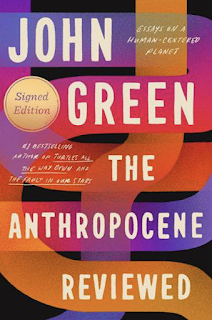
“The Anthropocene Reviewed, Reviewed” By Branden N


B


     The Anthropocene Reviewed: Essays on a Human-Centered Planet by John Green is a non-fiction book that brilliantly encapsulates many of the wonderful facets our planet has to offer through a compilation of 5-star reviews. But before I can continue this review, I must first define what the word “Anthropocene” means to those who are uninitiated. The Anthropocene is the time period in which humans had a profound influence on the Earth. Green masterfully analyzes how humans have impacted the Earth whether that be through topics that range from seemingly insignificant subjects such as his love of Diet Dr. Pepper to more weighty topics like comparing the black plague to our pandemic or more obscure issues of the ‘Yips’. No matter what topic it is, Green produces intriguing stories that always allow its readers to be drawn in.


Green typically opens each review with a personal anecdote usually of his past experiences with a certain topic. These personal anecdotes create more meaningful and personal connections between the author and their audience which helps Green introduce his thoughts and feelings about the topic. For instance, in many of Green’s essays, he would connect many of his stories to our contemporary world and especially about the pandemic. As a result, the theme of death became not uncommon, yet when it does come up, Green brings solace to the reader by telling them to cherish the memories they’ve had with their loved ones and the great moments we’ve had with them. Even though Green calls each 5-star review “essays”, they are much more interesting than what the word implies. The 5-star review Green does at the very end of each chapter also adds a personal touch like a yelp review on their experience at a restaurant.


What I love about this book is that it made me contemplate our influence on the planet and how we progressed during our time on Earth. One of my favorite quotes that shows Green’s thoughts about how special human life is, “We all know how loving ends. But I want to fall in love with the world anyway, to let it crack me open. I want to feel what there is to feel while I am here.” Many of Green’s perceptions of life can be pessimistic at times, but he would always try to comfort the reader soon afterward. Optimism, especially in the current state of our world, is very difficult to have; however, Green wants the reader to love our world and notes how lucky we have been to experience it, “What an astonishment to breathe on this breathing planet. What a blessing to be Earth loving Earth.”


There are many amusing and unique aspects of the book that drew me in. For example, right after the “contents” section, there is a small mini review on “half-title pages” where the page would simply state the main title without the author’s name or other subtitles. He’d claim that they are useless since the reader already knows about the title and gave half-title pages two and a half stars. You can tell that he put a lot of care into the design of this book because he pays attention to the reactions of his readers to even the smaller details such as the book’s half-title page. I also found it both amusing and ironic that in the back of the book there is a book ad on John Green’s previous works, and he writes a review of that book ad and found it “a bit gauche.”


I believe that this truly is a “good book” of both literary value and reader interest because it causes the reader to contemplate their time on Earth and how we progressed. We can see this through Green’s diction and his beautiful use of the English language. During Green’s review of the song, “Auld Lang Syne,” he talks about the hellish landscape of WWI and how British soldiers would repeat the phrase, “We’re here because we’re here” in the tune of Auld Lang Syne. Even though the story is dark, Green believes that the soldiers are not misguided and that “We might never know why we are here, but we can still proclaim in hope that we are here.” Our existence is truly a marvel to behold, and Green helps the reader understand that idea and made me contemplate on the preciousness of life and I believe that it will do so too for you.


I give The Anthropocene Reviewed four and a half stars.

Tuesday, September 28, 2021

Once Upon a Time in Hollywood-- book review by Justin G.


Once Upon a time in Hollywood was released in 2019 and was the 9th film released by Acclaimed Writer/ Director Quentin Tarantino. The expectations for this film were high and it certainly met them, earning praise from both critics and audience members as well as winning several academy awards. Once Upon a Time in Hollywood's positive reception made people even more excited for Tarantino’s tenth project, which in a surprising turn of events, was revealed to be a book. Tarantino released his debut novel entitled Once Upon a Time in Hollywood earlier this year, and it proved that Quentin Tarantino has a future as an author and that he can be more than just a scriptwriter.


When Tarantino said that this novelization was a complete rethinking of the story of the movie he was not wrong. Once Upon a Time in

Hollywood (the novel) is more of an ultimate directors cut to the movie than it is a novelization of the script. Massive elements of the story are changed in the novel and only about 30 percent of the movie's story is carried over. The rest of the book is made up of completely new story segments or reused scenes that are altered heavily and are almost unrecognizable. Once Upon a Time in Hollywood (from now on I will be referring to the novel unless specifically stated) is a period piece buddy comedy set in 1969 Hollywood. The late sixties and early seventies were a period of change in Hollywood. Many actors who were once prominent were beginning to fade into obscurity and new “method actors” were taking their place. Old school westerns and over the top war movies dominated the sixties and when Hollywood began to shift, many of the prominent actors who starred in these types of movies were left behind. At the same point in time a much darker shift was occurring in Hollywood. Hippy culture and the counterculture revolution began to rise. Once Upon a Time in Hollywood is set amongst this backdrop as it tells the story of how all these issues would combine to change history on one infamous night.

Once Upon a Time in Hollywood could be best described as an anthology book. It combines several different stories that interweave and combine to end up telling the story of the fall of 1960s Hollywood. Rick Dalton is a failing actor who is forced to take up a guest role in a tv show called Lancer after his movie acting career falls apart. His life is forever changed when he is offered a job to film spaghetti westerns in Italy by his producer Marvin. This leads Dalton through a path of self-discovery as he learns to take his future into his own hands and learns to survive in the changing world of Hollywood. Cliff Booth was a war hero in World War 2. Booth came back to the states a broken man and was unable to find a career. He traveled the world attempting to secure many different jobs but with no luck. He eventually met a famous actor


named Rick who convinced Cliff to become his stunt double. With Rick’s career failing, Cliff finds himself struggling to make a living and he becomes Rick’s chauffeur and handyman to make ends meet. Sharon Tate is a rising actor who is married to famed director Roman Polanski. Sharon Tate represents the Hollywood Dream. She moved to Hollywood with no money at all and she rose into stardom becoming one of the most promising up and coming actors in all of Hollywood. Polanski and Tate live on Cielo Dr which just so happens to be the same street where Rick Dalton resides. Charles Manson is a failed musician who managed to convince a group of young hippies to worship him. They took residence at Spahn movie ranch, an old movie set where Western tv shows used to be shot. Coincidentally Cliff Booth used to film westerns on this same movie ranch when he worked as a stuntman, and he was even friends with the owner, George Spahn. While many of these characters are fictional, Charles Manson and Sharon Tate are not, and the book is permeated with a level of suspense, especially if you are aware of the real-life events that took place at Cielo Dr on August 8th of 1969. The story of Once Upon a Time in Hollywood is a fascinating one. The way it is told and the characters present in the story make it very unique and a novel that is not easily put down.


The biggest strength of Once Upon a Time in Hollywood is the characters and the development they go through. Rick Dalton is a broken man who must learn to face the fact that he is a failure. One specific passage sees him reciting a passage that he had read in an old western dime novel about a cowboy who is old now and past his prime. This causes him to have a breakdown and you really sympathize with his character at this moment. Sharon Tate is also very likeable. She seems very carefree and relaxed all throughout the novel, and it makes her inevitable fate very heartbreaking. Tarantino also writes characters that are not so likeable, such as Charles Manson who of course committed one of the most heinous crimes in history. While his character is mocked and condemned, Tarantino did not take the easy way out, as he developed his character extensively and you get to learn a lot about his past. While all of those characters are very well written, Cliff Booth is one of the best characters that has ever been put to paper. Cliff Booth is not a good person. He has committed several unspeakable crimes and yet his character is so fascinating to learn about and the chapters about Cliff’s backstories were easily the highlights of the book. The characters in this book are so well developed and by the end you know even the most minute details about them. You even get an entire chapter dedicated to the backstory of Cliff’s Dog, and it’s great.


Once Upon a Time in Hollywood has many things going for it, but literary value is not one of them. While the novel is very entertaining, it lacks any deeper meaning. There is a message in the book about the changing environment of Hollywood, but it is not all that prevalent. While the book is very lacking in the thematic relevance, this book does excel in its use of allusions. There are a lot of allusions in this book, mainly to movies and actors of the time period, but also to pop culture. Aside from the allusions, this book has very little literary value. However, that does not mean that the book is bad, most of Tarantino's projects put style over substance, and this is no exception.

In general, the book is great, but it is not without issues. Some sections of the book seem more like Tarantino ranting than characters talking, but these sections are few and far between. The book also goes into much more detail than the movie, and this can both help and hurt the book, as sometimes the things that are being described feel more disturbing and uncomfortable than they needed to. There are also a lot of obscure references in this book that most likely will go over the reader’s heads. This is not a negative, but more of a stylistic choice that some people will like, and others will not. These complaints are relatively small, and they do not hurt the book very much at all.


All in all, would I recommend the book? Well sort of. If you are a fan of Tarantino or Once Upon a Time in Hollywood (the movie) then it is a must read. It is so much more than just a novelization of the movie’s script and you will most likely enjoy this book if you enjoyed the movie. If you are not a fan of Tarantino, then this book will not change your mind. If you have never seen a Tarantino film or have never heard of Tarantino, I would recommend watching all his movies, as they are all great, but only Once Upon a Time in Hollywood must be watched before this book is read. Once Upon a Time in Hollywood (the movie) is most well-known for its insane plot twist that will leave you in awe when the credits roll, and the book assumes that you already know this plot twist. Because the ending of the movie is spoiled early on in the book you must watch the movie first. Once Upon a Time in Hollywood is a great book. It is a quick read, and it checks all the boxes that you would want from a Tarantino book. It is very entertaining, and despite being rough around the edges (as is expected as this is Tarantino’s first book) it is solid. I would give it an 8/10 and a solid recommendation if you are a fan of Tarantino’s movies.